You clear a space beside your coffee, shuffle the deck, and put down three cards. That part feels manageable. Then you see the middle card and forget everything you read last night. Does the past card mean yesterday or childhood? Is the future card something you can change? And why does the little guidebook seem to be describing three different people?
The classic past, present, and future spread is a useful first layout because it gives each card a job. You are learning to connect an image to a question, then connect three observations to one another. You do not need a special cloth, a dramatic question, or an interpretation that sounds impressive when spoken aloud. A pencil helps more than any of those things.
In this guide, the future position means a possible direction if the relevant circumstances continue. It is an invitation to consider consequences, not a fixed appointment with fate. The examples use familiar Rider–Waite–Smith-style images and are invented for practice. Your deck's guidebook may suggest a different emphasis. Keep it nearby. Looking something up is part of learning, even when you have looked up that same card four times already.
Give the reading a small enough question
“What is my future?” asks three pieces of printed card to carry rather a lot. Try a situation you can describe without taking a deep breath first. “What can I learn about my difficulty returning to drawing?” has room for reflection. “What should I understand about the conversation I keep putting off?” also works. Both questions have a subject you can return to when an interpretation wanders.
Write the question before shuffling. Beside it, write a reasonable scope: the recent background, the situation now, and a possible direction over the coming few weeks. The time window is your chosen boundary for the exercise. It is not a claim that tarot can measure when events will happen. Without a boundary, a reader can move between last Tuesday and age seven until almost any story appears to fit.
Choose a question that belongs to you. You can explore your part in a friendship or your uncertainty about accepting an invitation. You cannot establish what another person secretly thinks by turning over a card. If your real question is whether your friend is upset, the reading might help you prepare to ask. It cannot supply their answer while they are somewhere else making lunch.
Set out the three positions before drawing
Place three cards in a horizontal row. From left to right, label them Past, Present, and Possible Future. If it helps, put three scraps of paper above the spaces before you shuffle. Beginners sometimes remember the cards clearly and forget which position each occupied. Labels spare you that small, annoying uncertainty when you return to your notes later.
For Past, use “relevant background.” For Present, use “what deserves attention now.” For Possible Future, use “where this may lead if the current approach continues.” Those longer descriptions prevent a few common mistakes. The past is not necessarily a complete account of what happened. The present is not an objective scan of your life. The future is not an instruction to sit still and wait.
Decide whether you will use reversals. If you are new, keeping every card upright is a perfectly usable choice. If you do use reversals, choose one approach before drawing, such as blocked or difficult expression of the card's theme. You can explore more methods later. For this first exercise, avoid changing your method simply because an upside-down card makes the answer less pleasant.
Shuffle in a way your hands can manage
Shuffle until you feel ready to draw, using whatever ordinary method keeps the cards secure. Overhand shuffling, mixing them on a clean table, or cutting a shuffled deck into piles can all form part of your routine. Small hands and stiff cardstock can make a fancy shuffle awkward. There is no need to bend your deck or scatter it onto the floor to prove that you are doing this properly.
Take three cards using the method you chose. Turn them over from left to right. Pause before opening the guidebook. Notice one plain detail in each picture: a person looking away, two figures exchanging something, a wall, a horse, a hand holding a coin. Write what you actually see before deciding what it must mean. “A person working alone” is an observation. “Nobody will ever support me” is already a very large interpretation.
Then consult the guidebook for a short phrase. Choose something relevant to the question rather than copying the entire entry. If your deck uses unillustrated numbered cards, lean more on its own instructions. You do not have to pretend to see a scene that the artist did not draw. The point is to find a manageable starting meaning for each position.
Read the past as background, not blame
Suppose the past card is the Eight of Pentacles in a reading about returning to drawing. You might connect it with earlier practice: filling pages with hands, learning to shade, making the same mistake repeatedly. Perhaps you once enjoyed that patient work. Perhaps lessons became so focused on improvement that you stopped playing. The card offers a theme to examine; your actual experience tells you which version has support.
A difficult card here does not require a hidden tragedy. Five of Cups might bring an ordinary disappointment into focus, such as one discouraging comment or a project you abandoned. Check whether that background is genuinely relevant. You are not obliged to find a painful memory for every uncomfortable picture. Sometimes the connection is weak, and “I do not know yet” is the most accurate note you can make.
Keep this position from becoming an accusation against your earlier self. “I gave up because I was lazy” closes the inquiry quickly. “I stopped after my schedule changed, and restarting began to feel embarrassing” tells you something you can work with. The past position is useful when it helps explain the present without turning explanation into a permanent identity.
Let the present card point to something observable
Imagine Four of Cups appears in the middle. In this example, it could prompt attention to disengagement: sketchbooks remain within reach, but opening one feels oddly unappealing. Before writing “I am rejecting opportunities,” look at the ordinary day. Are you exhausted after work? Do you spend your available half hour scrolling through other artists? Are you trying to resume a project you no longer like?
Different answers lead to different actions. If you are tired, a ten-minute exercise may fit better than an ambitious evening plan. If comparison is the problem, putting the phone in another room could help. If the project has lost its appeal, you might draw something else. The card alone cannot decide among these possibilities. It can help you notice where to look.
When a present card seems cheerful in a difficult situation, avoid forcing yourself to declare that everything is fine. The Sun might invite attention to a moment of clarity, a source of enjoyment, or something you can finally name. A card can describe one part of the situation without describing the whole week. The dishes may still be piled beside the sink.
Translate the future into a conditional sentence
For the third card, try beginning with “If I continue this approach…” or “One direction worth considering is…” That small language change matters. It keeps you involved in the reading. A future Eight of Pentacles might suggest gradual learning through repeated work. It does not promise a commission, a qualification, or a finished portfolio by a date the card has somehow encoded.
A future card you dislike can be used in the same way. Five of Wands might prompt a question about conflicting demands or a competitive atmosphere. What could you clarify now? Which commitment might collide with another? You can consider a response without treating the picture as proof that an argument is waiting around the corner. Sometimes the useful result is simply checking your calendar before saying yes again.
Do not convert a positive card into permission to ignore what you already know. If the future position looks encouraging but the proposed class clashes with your working hours, the clash remains. The reading may help you explore another route. It cannot make Wednesday evening free. The most useful interpretation often becomes less grand when you bring it back to the details of your actual life.
A complete example at an ordinary table
Consider an invented reader, Leila, whose question is, “What can help me return to drawing during the next three weeks?” Her positions use recent background, present attention, and a possible direction. She draws Eight of Pentacles, Four of Cups, and Page of Wands. She writes the cards down before doing anything else because she knows she will forget the first one once she starts thinking about the last.
For the past, Leila remembers an evening class where she practiced carefully but became preoccupied with doing things correctly. For the present, she notices her lack of interest in finishing the exact still life she abandoned. For the possible future, she treats Page of Wands as an invitation to experiment. Her first sentence is: “Earlier discipline became dull, and a small new experiment may make it easier to begin again.”
That sentence leaves something out. Leila has also been working late. She adds it to her notes instead of making the cards explain everything. Her plan becomes modest: draw one object at breakfast on Saturday, using a pen so she cannot spend the whole time erasing. She chooses the bent spoon she dislikes. It is available, and nobody needs to see the result.
Two weeks later, she has drawn three times. Once she enjoyed it. Once she was distracted. The third drawing looked worse than the first. Her review says the new subject helped her start, while the early time slot mattered more than she expected. She does not write that the Page predicted artistic success. The reading helped her try something specific, and the attempt gave her information the cards could not.
Connect the cards without flattening their differences
Three separate dictionary entries are a start, but a spread becomes more useful when you ask how the positions relate. Does the present continue the past? Does it resist it? Does the possible future suggest more of the same or a change in approach? Use ordinary connecting words. “Because,” “but,” and “so” often do more useful work than a paragraph full of spiritual vocabulary.
For example, Six of Cups in the past and The Fool in the present could raise a question about familiarity and beginning. Perhaps an old interest makes a new experiment feel inviting. Perhaps nostalgia makes the new situation difficult to see clearly. The third card and the actual question can help you choose an emphasis. You can read more about this process in the guide to card combinations.
Keep one alternative interpretation in your notes when the connection is uncertain. You might write, “This could concern boredom, though tiredness seems at least as likely.” That is useful restraint. It also makes later review more honest. You will be less tempted to remember your reading as precise if you recorded where it was tentative at the time.
Try a different three-card layout when time is the wrong question
Past, present, and future is not always the best fit. If you are deciding how to reply to an awkward message, Situation, My Response, and A Helpful Next Step may be easier to use. If you are comparing two invitations, try Option A, Option B, and What Matters Most. Choose the positions before drawing and write their names down. Otherwise it becomes too easy to move the difficult card into a more comfortable job.
Another gentle layout is What I Notice, What I May Be Missing, and What I Can Check. The last position is especially valuable because it asks for contact with reality. You might check a deadline, ask what a friend meant, or read the instructions you skimmed. A reflective practice becomes sturdier when it sends you back to something you can observe rather than keeping you at the table indefinitely.
Avoid calling every unfamiliar feeling intuition. The High Priestess reversed guide offers a useful companion when silence, uncertainty, and your own assumptions become tangled. A quiet impression may deserve attention. It still deserves a careful question, especially when the interpretation concerns someone who has not spoken for themselves.
Close the reading while it is still small
Finish by writing the question, three position meanings, one connecting sentence, and one thing you will do or notice. Photograph the layout if that helps, but keep the written sentence too. A photograph preserves the cards; it does not preserve the meaning you gave them. Later, those can feel surprisingly different.
If the spread remains confusing, put it away without adding another six cards. You can return after dinner or leave it unresolved. Learning includes readings that do not produce a satisfying answer. The next useful step may be practicing a single position tomorrow. For now, three cards, a few honest notes, and enough room on the table for your coffee are plenty.
Book recommendation
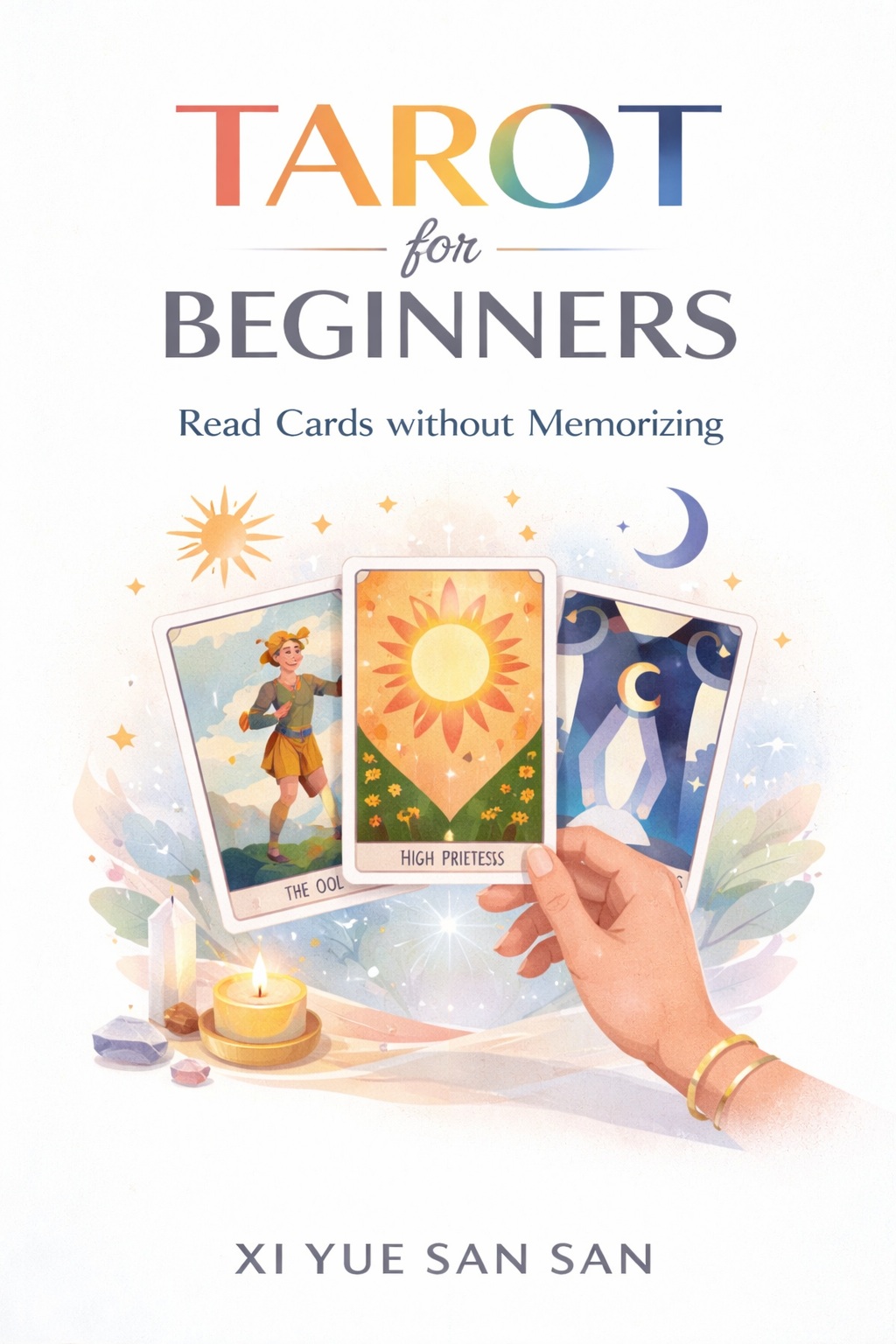
Tarot for Beginners. The catalog describes an approach to reading without memorizing. It pairs well with this first spread, where noticing an image and giving each position a clear job matter more than reciting keywords.
Open the book page