There is a particular way people say “maybe next time” when they cannot afford dinner out. A little too quickly. They add something about being busy, then look at the menu again as though checking a message. Nobody at the table may notice. The person saying it notices everything: the price of the shared starter, the suggestion to split the bill evenly, the taxi somebody assumes everyone can take home.
The Five of Pentacles often enters a reading near experiences like this. In contemporary tarot, it can represent material strain, insecurity, exclusion, or the feeling of being outside a place where other people seem comfortable. Those possibilities overlap, but they are not interchangeable. An actual lack of money needs to be distinguished from a fear of rejection and from a setting that really is excluding someone.
The card cannot diagnose your finances or predict that you will lose your job. It can help you ask more precise questions about what is missing, what hurts, and what support is realistically available. This is a guide to reading the symbol, not financial advice or a promise that a change in attitude will solve a shortage.
Begin with the people in the snow
In the Rider–Waite–Smith image, two poorly clothed figures pass through snow beneath a lit window. One uses crutches. Five pentacles appear in the window. The contrast between the people outside and the illuminated building is immediate. You can see exposure and difficulty before you consult a guidebook.
Waite's Five of Pentacles description connects the scene with material hardship. Many current readers also use it to discuss exclusion and support. Those are interpretive possibilities. The image does not show whether a door is open, whether help is welcoming, or whether the people have already asked. Do not invent those details and then blame the figures for walking past.
This matters when someone says, “The help is right there; you just refuse to see it.” Sometimes help is available and difficult to request. Sometimes it is inaccessible, conditional, inadequate, or humiliating to obtain. A responsible reading asks which situation applies. The window can prompt a question about support without guaranteeing that the answer is easy.
Three different questions hiding in one card
Start with material circumstances. Is there an actual shortage of money, time, housing security, equipment, or practical assistance? If the answer is yes, name it plainly. Someone whose hours have been cut does not need a lecture about thinking abundantly. They may need information, options, and other people who understand the situation well enough to be useful.
Then consider belonging. Is the person being excluded, or do they fear that revealing a difficulty would change how others treat them? A group that insists on expensive activities can create real barriers without intending to. A friend who would happily meet for a walk cannot offer that alternative if everyone keeps pretending the restaurant is fine. The facts may be different from one friendship to another.
Finally, consider the story attached to the difficulty. “I cannot afford this dinner” describes a circumstance. “I should never see my friends until I earn more” adds a broad conclusion. The second statement may deserve examination even while the first remains true. The Suit of Pentacles is a useful companion here because it keeps attention on the actual conditions of daily life.
Why “poverty mindset” can become an accusation
The phrase sometimes points toward habits of thought: expecting rejection before asking a question, feeling ashamed of ordinary needs, or assuming that comfort is only for other people. Used carefully, it may help someone notice a belief they want to reconsider. Used carelessly, it suggests that people create deprivation by having the wrong feelings about it.
A tarot card cannot establish that claim. Low pay, interrupted work, expensive care, inaccessible services, and unequal opportunities do not become imaginary because a person worries about them. Nor does a positive reading make a bill disappear. If the phrase makes someone feel blamed for circumstances they did not choose, put the phrase aside and ask a more concrete question.
For example, “What makes it difficult to tell your friend that this plan costs too much?” allows several answers. Embarrassment might be part of it. So might past ridicule. So might the knowledge that the friend has dismissed the issue before. You learn more by listening to the answer than by assuming every closed door began as a belief.
What upright can mean in a reading
Upright, the Five of Pentacles often brings attention to vulnerability, shortage, or a difficult period of feeling unsupported. The exact meaning should come from the question and the person's context. In a reading about belonging at work, it may describe being left out of important conversations. In a reading about a household, it may describe too few resources for too many demands.
Be specific about who is experiencing the difficulty. A household can look comfortable from outside while one member has little access to its resources. A person can earn a decent salary and still lack the time or assistance needed for daily responsibilities. The card's material emphasis is broader than the number in a bank account, though that number may matter a great deal.
If the position concerns advice, the card might invite acknowledgment of a need that has been concealed. It need not instruct the person to endure more or become grateful for less. A useful interpretation might be, “This situation seems difficult to manage alone; what kind of help would actually change your week?” Let the answer determine where the conversation goes.
Reversed does not guarantee a rescue
Some readers interpret the reversed Five of Pentacles as emerging from isolation or beginning to find assistance. Others use it for hardship that is hidden, prolonged, or especially difficult to discuss. Both approaches exist. Decide how you use reversals before the reading, and resist choosing a brighter interpretation solely because the upright image feels uncomfortable.
If you read it as improvement, connect that interpretation to something observable. Has a conversation opened? Has someone offered practical help? Has a barrier become clearer? Even then, the card cannot guarantee a payment, an approval, or a job offer. It may be more useful to say that the person is beginning to explore a way forward than to promise an outcome.
If you read it as private difficulty, ask gently whether the person has room to discuss it. Some people have good reasons to keep their circumstances confidential. They do not owe every friend, colleague, or tarot reader a complete account. Choosing a trustworthy person and a limited request can be more helpful than turning disclosure itself into a moral achievement.
Love readings: being together and feeling outside
The Five of Pentacles in a relationship reading can resonate with loneliness inside a partnership. Perhaps one person makes decisions and the other hears about them afterward. Perhaps money differences make shared plans awkward. Perhaps both partners are under pressure and have stopped asking how the other is managing. The card should open a conversation about the specific experience.
It does not prove that a partner will leave. It also does not establish that someone is using you for money. Those are serious claims about another person's actions and intentions. If there are concrete concerns, discuss the concerns directly. A card is not a substitute for noticing who controls information, who gets a say, and how each person responds to a reasonable request.
An ordinary question can be revealing: “When we make plans, can both of us say what we can afford without embarrassment?” The answer may uncover a manageable mismatch or a more troubling pattern. The reading is useful when it helps the person articulate that question. It is less useful when it invents a dramatic explanation and leaves them too frightened to ask.
Work readings: access is part of opportunity
Picture a new employee who discovers that project decisions are often made during informal drinks after work. They cannot attend because the last bus home leaves early and they have responsibilities waiting. On paper, everyone has the same invitation. In practice, access is uneven. The Five of Pentacles can help describe that difference without reducing it to a lack of confidence.
In another workplace, the exclusion may be less deliberate: missing training, unclear instructions, or an assumption that everybody already knows how to use a tool. A reading might prompt the employee to identify what information is missing and whom they can ask. It should not announce that colleagues secretly dislike them. That conclusion needs evidence the spread cannot provide.
The Justice card can add a useful question about fairness and access when it appears nearby. Keep the discussion grounded in what has happened and what can be clarified. If the situation involves legal rights or financial decisions, appropriate professional information belongs alongside the reflection. Tarot cannot determine those matters.
A worked example with a less dramatic ending
Consider a fictional querent who asks, “Why have I started avoiding my friends?” The Five of Pentacles appears in the position describing the present situation. The reader first checks the obvious: has anything happened in the group? The querent explains that every recent invitation has involved spending they cannot comfortably manage. They have begun declining without explanation.
The reader does not assume the friends are cruel or that the querent is self-sabotaging. They ask whether anyone in the group knows about the difficulty. One friend does, and has previously suggested inexpensive plans. That is relevant information. The lit window in the card can now become a prompt to notice a particular relationship where a conversation may be possible.
The querent decides to suggest a walk to that friend. Perhaps the friend agrees. Perhaps the weather is dreadful and they sit in a kitchen instead. No windfall occurs; the underlying money problem remains. Yet the person no longer has to treat every social contact as a purchase. The reading has helped with one part of the situation while leaving another part unresolved.
A spread that separates need from shame
Use four positions if you want a practical reflective exercise: what is concretely missing, what feeling accompanies that lack, where support might be explored, and what boundary deserves respect. Write the positions before drawing. For the first, check your interpretation against actual circumstances. If the card suggests a shortage of time but money is the immediate concern, do not ignore the person's correction.
For the feeling position, make room for mixed reactions. Someone can be grateful for help and resent the conditions attached to it. They can feel embarrassed while knowing intellectually that they have done nothing wrong. Naming a feeling is different from endorsing the story it tells. “I feel like a burden” should not be translated into “I am a burden.”
For support, identify a possibility to investigate rather than a promised rescuer. For the boundary position, ask what the person would need to retain: privacy, a say in the arrangement, freedom to decline, or a clear understanding of expectations. Assistance that creates new pressure deserves careful consideration. The cards can organize the questions; real conversations must supply the terms.
Asking for help without explaining your whole life
Some requests become harder because they are imagined as a confession. You picture telling someone every mistake, every expense, and every reason you should have handled things differently. A more limited request may be possible. “Could we choose somewhere less expensive?” does not require a detailed account of your income. “Can you show me how this process works?” does not require announcing that you feel incompetent.
If you are the friend receiving such a request, listen to what was actually asked. Do not immediately take control, demand proof of hardship, or turn the conversation into a story about how you solved your own problems. The person may want a different meeting place, not an unsolicited plan for their entire life. Respect makes practical help easier to accept.
Sometimes the answer will still be no. A declined request can be disappointing without confirming that nobody cares. It may tell you about that person's capacity, the limits of a particular service, or the need to look elsewhere. A reading should leave room for those realities. It should not make every disappointing answer into a verdict on your worth.
Read the card without leaving anyone outside
The Five of Pentacles asks for a kind of attention that is easy to miss when a reading becomes too interested in hidden meanings. Someone may be cold, tired, embarrassed, short of resources, or simply excluded from the conversation. Begin there. Ask what the person says is difficult before offering an interpretation of why it happened.
You may leave the reading with an exact request, a clearer boundary, or a better distinction between circumstance and shame. You may also leave with a problem that still needs practical assistance. That is not a failure to read deeply enough. Sometimes the most accurate reading admits that the difficulty is real, the help is uncertain, and the person deserves to be treated with dignity while they work out what comes next.
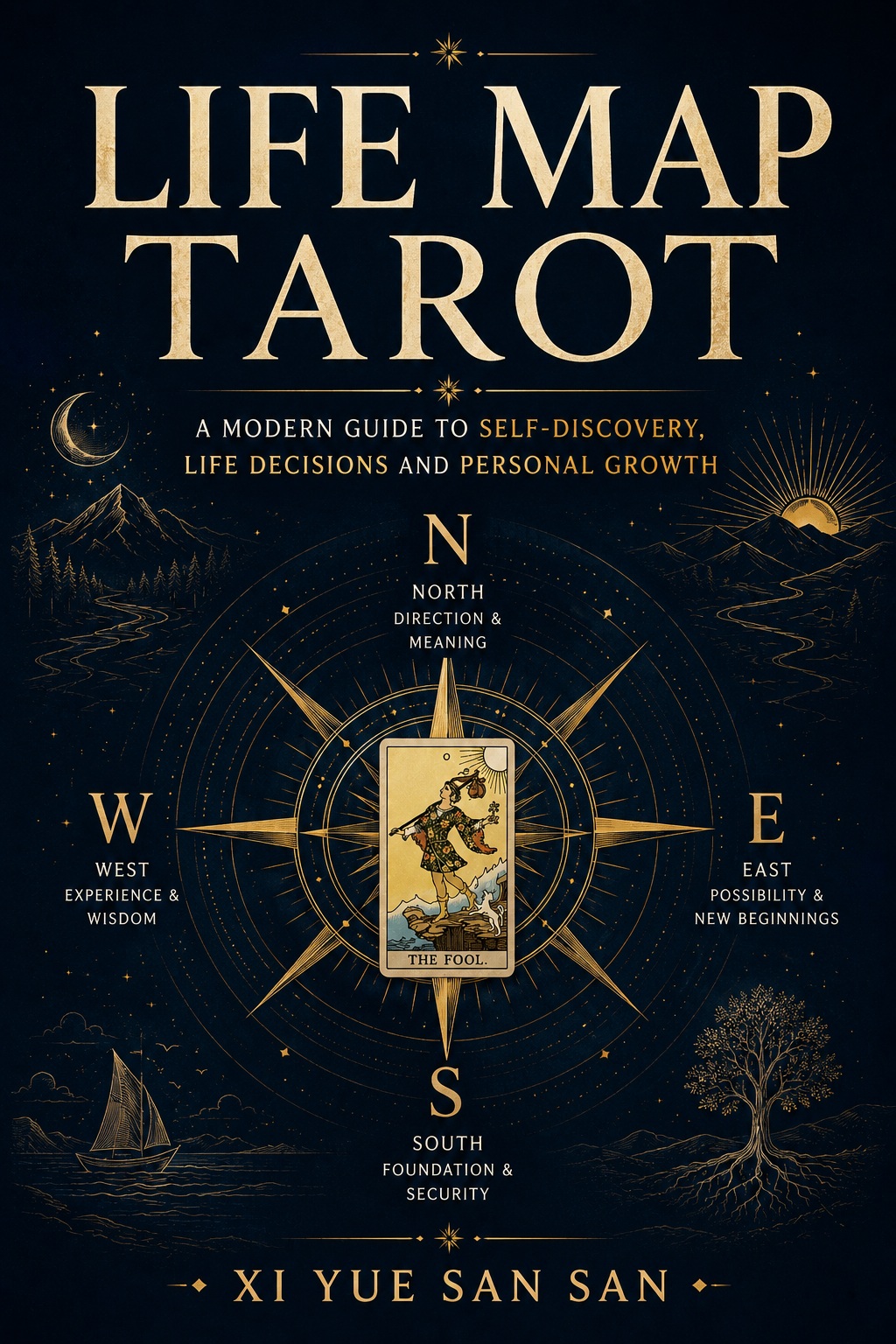
Book recommendation
Life Map Tarot. Its focus on decisions and self-reflection fits the questions this card raises about practical needs, possible support, and the choices that remain yours.
Open the book page