The family photograph looks lovely. Everyone is dressed, the children are more or less facing the camera, and somebody has moved the laundry basket out of view. Ten minutes earlier there was an argument about who was supposed to bring the food. Later, one person will wash up while everybody else sits down. The happiness in the picture may be real. It is not the whole household.
The Ten of Cups and the Ten of Pentacles often appear in readings about a good life: belonging, relationships, home, continuity, and the things people hope will last. Because both can look reassuring, it is tempting to flatten them into “happy ending.” Their differences are more useful than that. Cups commonly invites attention to emotional connection. Pentacles commonly invites attention to the material and social arrangements that support a life over time.
Neither card guarantees a marriage, inheritance, pregnancy, or permanent security. This guide treats them as images through which to examine your own idea of fulfillment. The Rider–Waite–Smith scenes provide the starting point, while your actual relationships and circumstances determine what deserves attention.
Two pictures of belonging
The Ten of Cups shows a couple looking toward cups arranged across a rainbow, with children nearby and a home in the landscape. The Ten of Pentacles gathers several generations, dogs, and a built setting into a more crowded scene. One image invites attention toward shared joy. The other invites attention toward a household and what continues through it.
You can compare the early descriptions in Waite's Ten of Cups entry and Ten of Pentacles entry. The modern questions in this essay extend those images into daily life; they do not establish one mandatory form of happiness. The people on a card are not instructions to reproduce their household.
A person living alone may have deep belonging. A couple without children may be building a rich shared life. Friends can provide continuity that relatives do not. Start by asking what the querent means by home, family, and security. If you skip that question, you may end up reading your own preferences while the person across the table politely waits for their life to enter the conversation.
Ten of Cups: can I be myself with these people?
The Ten of Cups is often associated with emotional fulfillment, harmony, shared happiness, and belonging. In a practical reading, those themes might lead you to ask where you feel welcome without having to perform. Who can hear that you are disappointed? Who notices when you go quiet? Where can you enjoy yourself without monitoring everybody else's mood?
Emotional belonging can appear in small moments. Someone keeps a portion of dinner for you when you are late. A friend remembers a difficult anniversary. You disagree with a partner and discover that the disagreement does not threaten the whole relationship. These examples are less picturesque than a rainbow, but they give the idea of harmony something you can recognize.
The Suit of Cups provides a broader emotional vocabulary for this reading. The Ten does not mean that everyone feels good all the time. A relationship in which sadness and frustration can be spoken may offer more genuine ease than one in which everybody must remain cheerful to keep the peace. Ask what happens on the ordinary bad days, too.
Ten of Pentacles: what helps this life continue?
The Ten of Pentacles often brings up continuity, shared resources, family arrangements, established institutions, and the practical side of belonging. It may point toward the things that make a household or community durable: reliable routines, a place to gather, accumulated knowledge, mutual responsibilities, and resources that can be passed along.
Money can be part of this conversation, but it is not the only part. An aunt who teaches you how to repair a coat passes on something useful. A shared address book, a family recipe, or a neighbor who has a spare key can support daily life. These forms of continuity may matter alongside property and savings, rather than replacing the need for material security.
In the Suit of Pentacles, care often becomes visible through practical arrangements. With the Ten, ask who maintains those arrangements and who benefits from them. A family can own a comfortable home while depending on one exhausted person to keep everything running. The image of stability deserves a closer look at the labor inside it.
The difference shows up during an inconvenient week
Imagine that the boiler stops working, a deadline moves forward, and someone needs collecting from the station. In one household, everyone has money available but nobody will discuss who should help. In another, people communicate warmly but there is little practical capacity to handle the unexpected expense. Neither situation is adequately described by a simple division between love and money.
The Ten of Cups asks about the quality of the response: can people listen, cooperate, and remain considerate under pressure? The Ten of Pentacles asks about the available arrangements: who has time, what resources exist, and how responsibilities are shared. These questions overlap because human lives overlap. A kind intention still needs a way to become useful.
Try describing the two cards without ranking them. Emotional connection is not automatically deeper than practical support. Practical support is not automatically more mature than affection. Different circumstances may make one need more urgent. The reading becomes clearer when it asks what is missing now, rather than declaring which form of fulfillment should matter most to everyone.
Love readings: a relationship and the life around it
The Ten of Cups in a love reading may invite attention to emotional compatibility and a shared sense of belonging. Can each person speak honestly? Do both feel included in the imagined future? Does the relationship allow individual preferences, or is one person always adjusting so that the couple can appear harmonious? The card opens these questions; it does not answer them by appearing.
The Ten of Pentacles may bring the surrounding life into focus: housing, relatives, traditions, responsibilities, and long-term arrangements. It can be particularly useful when a couple is considering how their lives fit together in practice. A shared future contains more than shared affection. It also contains decisions about where to live, how to spend time, and whose expectations enter the room.
If both cards appear, avoid immediately announcing marriage. They may describe a hope for a settled partnership, a conversation about family, or a need to connect emotional wishes with practical realities. Ask what the relationship currently demonstrates. Someone talking warmly about a future is different from two people making mutually agreed arrangements. Both can matter; they are different kinds of evidence.
When the happy picture becomes a rule
Every family has a story about itself. Perhaps yours is the close family, the hardworking family, the family that never gives up on one another. Those stories can offer comfort. They can also make it difficult to say, “This arrangement is not working for me.” Nobody wants to be the person who spoils the photograph.
In a challenging position, the Ten of Cups might invite you to examine pressure to look happy. The Ten of Pentacles might invite you to examine inherited expectations or practical dependence. These are possible readings, not accusations against your relatives. Ask for concrete examples. What happens when someone declines an invitation, chooses a different career, or wants to spend a holiday elsewhere?
The Hierophant's themes of tradition and belonging can be useful alongside the Tens. Traditions may offer support, continuity, and shared meaning. They may also need negotiation. You do not have to call a tradition entirely good or entirely harmful before considering whether you want to keep participating in it in the same way.
Reversals: examine the mismatch
For the Ten of Cups reversed, some readers explore disappointment in an ideal, emotional disconnection, or the strain of pretending that everyone is content. Others read a private or unconventional form of fulfillment. Decide which reversal method you are using. Do not assume that a reversed family image announces divorce or proves that affection is absent.
For the Ten of Pentacles reversed, a reading might consider tension around shared resources, uncertain arrangements, competing family expectations, or a wish to choose a different path. It is not a financial forecast. If a concrete money or legal question is involved, the relevant documents and qualified advice are more appropriate sources of answers than a reversed card.
Sometimes the most useful reversal question is simply, “Where does the current arrangement differ from what you thought it would feel like?” Someone may have achieved the life they planned and still be unhappy. Someone else may have an unconventional life that suits them well but keeps being judged against another person's template. Both deserve a reading that leaves room for their own account.
Work and community can hold these themes too
The Tens are not confined to romance or domestic life. A workplace can offer warmth and a strong sense of team while lacking dependable pay or reasonable hours. Another can offer stable conditions and professional development while feeling emotionally distant. The cards can help you distinguish what you appreciate from what you are still missing.
Do not let a company's language of family erase the fact that it is a workplace. A Ten of Cups interpretation about belonging should not require unlimited loyalty. A Ten of Pentacles interpretation about continuity should not imply that an established organization is automatically fair. Ask about the actual experience: are commitments kept, responsibilities clear, and disagreements handled respectfully?
In community life, the Ten of Cups might describe the pleasure of being known. The Ten of Pentacles might describe the hall, equipment, records, and volunteer work that allow the group to continue. A wonderful monthly gathering usually depends on someone remembering the key and checking the heating. Noticing that person may be the most useful practical response to the reading.
A worked comparison with the same question
Take the question, “What would help us decide whether to move in together?” If the Ten of Cups appears as the focus, you might begin with the emotional experience each person hopes for. One wants easy companionship; the other wants more privacy than they have previously admitted. They can care about each other and still need to discuss what an ordinary evening will look like.
If the Ten of Pentacles appears instead, you might begin with arrangements. Whose furniture comes along? What responsibilities will be shared? How will visits from relatives work? What needs to be clarified before a commitment is made? The reading should generate questions to discuss, rather than taking the place of practical planning or an agreement.
If both appear, let them challenge each other constructively. “We will feel closer” needs consideration of how the home will actually function. “It will be convenient” needs consideration of whether both people want the emotional change. The conversation may end with enthusiasm, hesitation, or a decision to wait. A useful reading allows all of those outcomes instead of treating a positive-looking card as a command.
Write your own definition of enough
For a journal exercise, divide a page into two columns. In the first, write “I feel I belong when…” In the second, write “Daily life feels supported when…” Complete each sentence with several concrete examples. Try to avoid answers that sound like a brochure. “I can say I am tired without being teased” tells you more than “loving environment.”
Now mark which examples already exist, which are shared wishes, and which depend on another person's agreement. You might discover that you have overlooked a source of support. You might discover that you have been treating a private hope as a shared plan. Neither discovery needs an immediate dramatic response. Start with one item that could become a conversation.
Repeat the exercise at another stage of life if it remains useful. Your definition of fulfillment can change after moving, becoming a caregiver, ending a relationship, finding new friends, or simply learning what you actually enjoy. The Tens do not require you to preserve an old picture of happiness after it no longer fits. They can help you examine what you want to keep and what you need to revise.
A good life still contains unfinished dishes
The Ten of Cups and Ten of Pentacles are reassuring partly because they invite us to imagine that some effort can become a life we enjoy inhabiting. That wish is understandable. It is also easy to load the cards with so much expectation that no real household, friendship, or partnership can survive the comparison.
Let the images ask useful questions without becoming standards you must perform. Is there room for honest feeling? Is there practical support? Who carries the invisible work? Whose version of happiness is being followed? You do not have to answer all of them in one reading. You may begin by noticing who is still in the kitchen after the photograph, and whether anyone has thought to join them.
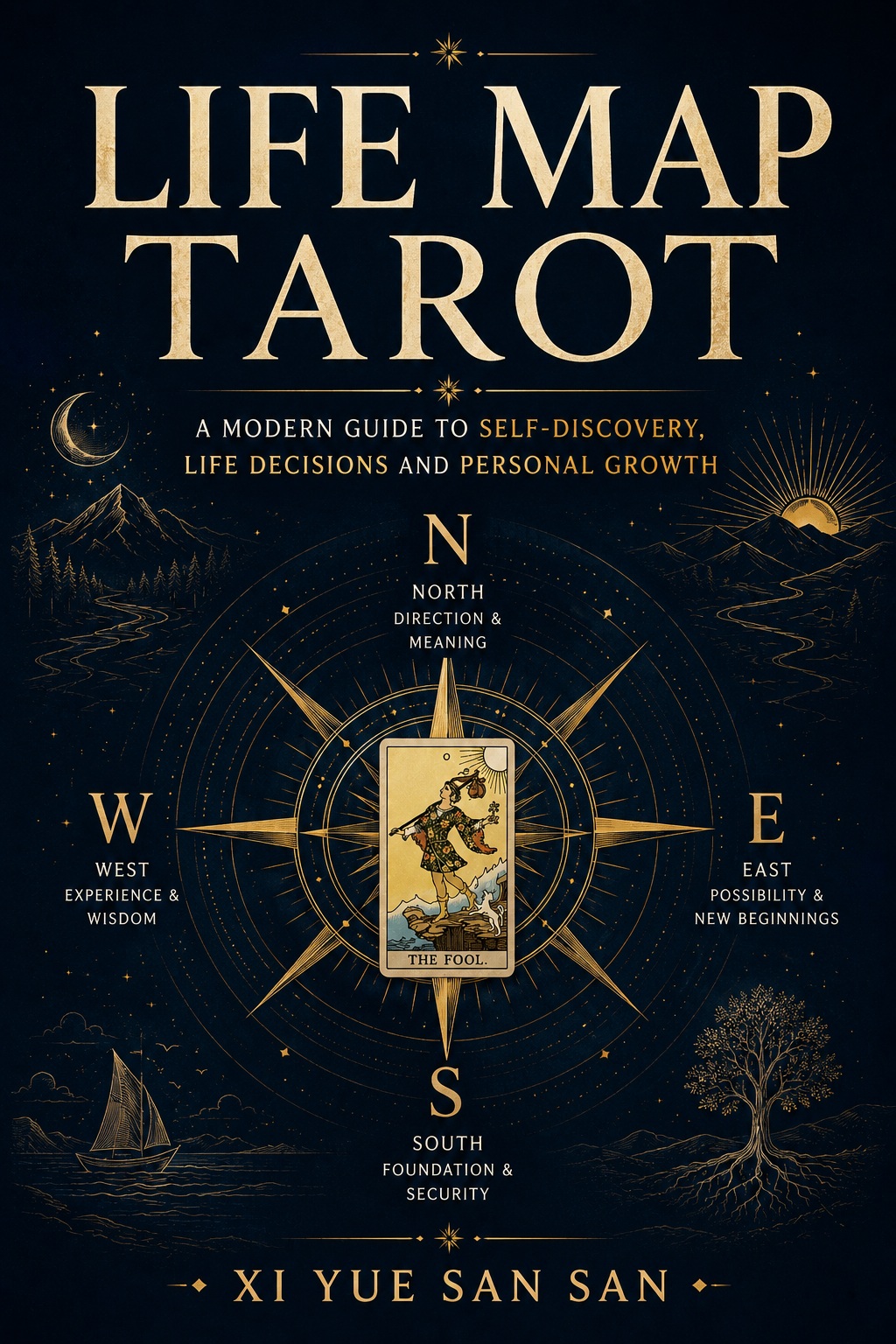
Book recommendation
Life Map Tarot. A useful companion for reflecting on the life you want to build. Its focus on decisions fits this comparison of emotional wishes and everyday arrangements.
Open the book page