The message arrives between a delivery notification and a reminder to book the dentist. An old colleague asks whether you would be interested in a short project. There is no formal job description yet. You read it twice, imagine an entirely different working life, then notice the phrase "We don't have much budget." Unexpected opportunities often arrive like this: a real possibility mixed with missing information, bad timing, and the awkward question of whether you can afford to be excited.
When you ask tarot what career opportunities are coming this month, you may be asking for relief from sameness. You want evidence that your life has not narrowed to the same commute and the same unanswered request. That wish makes sense. The cards cannot forecast an offer or guarantee a date. They can help you notice which possibilities you are prepared to recognize and what you might do when something unfamiliar appears.
There is a difference between staying receptive and putting your life on hold for a predicted arrival. This essay is about the former. You can make room for surprise while continuing to do the work of finding opportunities. Start with the calendar you actually have. Count the evenings already occupied, the commitments you cannot move, and the hours you could reasonably give to exploring something new. Possibility needs some space in an ordinary week.
Unexpected does not have to mean dramatic
An opportunity might be an invitation to interview. It might also be permission to attend a meeting, help on a project, learn from a colleague, or take over one task that interests you. These smaller openings are easy to dismiss because they do not immediately change your title. Some are useful. Some are simply extra work. The difference becomes clearer when you ask what the experience offers and what it asks of you.
Imagine you are asked to show a new colleague how you organize customer queries. You discover that explaining the process is more satisfying than answering the queries yourself. That does not mean you are destined to become a trainer. It does give you a reason to explore training work. The unexpected part is the information you learn about your preferences. A career opportunity can begin as a better question, before it becomes an external offer.
The Page of Wands can be read as curiosity that has not yet earned certainty. If it appears, try identifying one thing you want to investigate rather than declaring that a breakthrough is imminent. The Page of Pentacles may suggest something that requires practice: a new tool, a modest assignment, a class you can realistically complete. Neither card tells you that an invitation will arrive on Thursday. They can help you decide where to direct your attention on Thursday.
Make a little room to be contacted
You do not need to announce a complete professional reinvention. A short update to someone you already know may be enough: "I have been doing more editing recently and would be interested in small projects in that area." Specificity gives people something to remember. "Let me know if you hear of anything" asks them to imagine your whole future for you. They may care about you and still have no idea what to suggest.
Check the ordinary places where an opening could be lost. Is your contact address current? Is the work sample you share still representative? Have you ignored a message because answering now would require admitting how long you left it? A late but honest reply can be brief. "I missed this during a busy stretch. If the conversation is still relevant, I would be glad to hear more." There is no need to write a confession.
You are not causing the universe to deliver a job by updating a profile. You are making it easier for a real person to understand your interests and reach you. That distinction keeps disappointment from turning into self-blame. You can do everything sensibly and hear nothing this month. Other people's budgets, priorities, and attention are involved. Your effort matters without giving you control over all of those things.
A spread for recognizing a useful opening
Use four cards with four separate questions. What kind of work am I curious about now? What makes me overlook a possibility? What practical detail should I ask about first? What small action can I take this week? Keep the reading about your attention and choices. Avoid a position labeled "The exact opportunity coming toward me" unless you can resist treating the image as a report from the future.
Suppose the Three of Cups appears for curiosity. You might explore work that involves collaboration or an existing community. Four of Cups in the second position could prompt you to notice that exhaustion has made every invitation look irritating. Justice in the third could direct attention to clear terms. Eight of Wands in the fourth might suggest responding to a real message promptly. The reading becomes useful through those actions, not through a promise that someone will contact you.
Write one sentence under each card. Keep it short enough to reread next week. If you find yourself writing several paragraphs about the personality of an employer you have not met, come back to the question. You cannot verify an imagined employer. You can verify whether you sent a message, asked about payment, or made time to examine an opportunity you would normally dismiss.
Ask what the invitation actually includes
Enthusiasm can make you agree before you understand the task. Someone says, "It would be great exposure," and you find yourself promising a weekend because declining feels ungrateful. Slow the exchange down. Ask about the work, expected hours, payment, deadline, decision maker, and what happens after the initial conversation. These questions are not hostile. They help both people discover whether the opportunity fits.
For a fictional example, let Jo receive an invitation to contribute to a launch. She likes the team and wants more creative work. The first description sounds like two afternoons. After asking for details, she learns that it includes six weeks of revisions and evening meetings. There may still be reasons to accept, but it is a different decision now. The surprise was not automatically a gift. It needed a description.
If a reader pulls the Ace of Pentacles for this situation, the card might help them notice a potentially useful beginning. It does not certify the offer's value or the organizer's reliability. Compare the invitation with your available time and needs. Ask for relevant terms in writing. You do not have to turn suspicion into your default posture, but warmth should not replace information that affects your work.
Notice when novelty is doing all the persuading
A new possibility can look especially beautiful after a dull week. You have answered the same question nine times, eaten lunch at your desk, and watched another meeting drift past its ending. Then someone mentions a different kind of project, and the mere fact that it is different feels like proof. Give yourself a moment to enjoy that feeling. Then ask what the work would be like on an ordinary tired day.
The Seven of Cups can be read as several attractive possibilities that have not been tested. Try describing the actual tasks behind each one. A podcast project includes scheduling, editing, and chasing approvals. A small shop includes stock questions and customer messages. A consulting opportunity includes finding out what the client means when they say they want "fresh thinking." If the everyday work still interests you, that tells you more than the title.
You may find that you want novelty inside your current role rather than a complete exit. Ask to observe another team, change one recurring assignment, or contribute a specific skill to an upcoming project. The request may be refused. Even then, making it can clarify what you are missing. You have moved from "Anything else would be better" to "I want more of this particular kind of work."
Keep a small opportunity record
Use a notebook page, not a complicated tracking project. Record the invitation or idea, why it interests you, what is still unknown, and the next date for action. Include possibilities you create yourself, such as contacting a former colleague. Otherwise you may forget those efforts and remember only the openings that seem to arrive by magic. Most professional paths contain some of both: chance encounters and ordinary follow-up.
The record can also prevent urgency from deciding for you. If someone says they need an answer immediately, note that pressure alongside the details. A real deadline may exist. You can still ask whether there is enough time to understand what you are accepting. "I can answer tomorrow after reviewing the scope" is a reasonable sentence. If that makes the offer disappear, you have learned something relevant about the conditions attached to it.
Review the page once a week. Close the possibilities that have clearly ended. Follow up where a response is due. Leave uncertain ones marked uncertain rather than promoting them to future income in your imagination. An encouraging conversation is not a confirmed job. Keeping that distinction on paper lets you remain interested without making next month's plans depend on someone else's unfinished decision.
Try something small enough to learn from
Some openings deserve a limited experiment. You could attend one event, discuss a defined assignment, or spend an afternoon making a sample that uses no confidential employer material. Decide what you want to learn before beginning. Do you enjoy the task? Can you do it within the time available? Does the other person communicate clearly? These are answerable questions. "Is this my entire future?" usually is not.
Be careful with experiments that quietly become commitments. A sample should have an agreed purpose and scope. A favor should not expand indefinitely because you want to seem easy to work with. If the arrangement changes, pause and discuss it. The Two of Pentacles can invite attention to what you are already carrying. Adding one more thing may be manageable; adding it while pretending nothing else changes can leave you resentful.
You are allowed to decide that the experiment was useful and the path is not for you. That is not a failed manifestation. Perhaps the meetings drain you, or the task is less interesting than it looked from outside. Thank the people involved where appropriate, close the commitment responsibly, and keep what you learned. You do not owe every interesting opening a permanent place in your life.
When the month stays quiet
Suppose you reach the last week and nothing obvious has arrived. The temptation is to pull more cards and find a delayed prediction: next month, after a change in energy, once you stop doubting. That can keep hope alive while also making it impossible to evaluate the reading. Consider a different review. What did you try? What responses did you receive? What new information do you have about the work you want?
Maybe you discovered that the role you imagined requires a qualification you do not have. Maybe two people told you hiring is paused in their teams. Maybe a conversation was pleasant but led nowhere. None of these is the grand answer you hoped for. They still help you choose a next step. You might explore a different route, wait with a defined reason, or stop giving time to a possibility that is not developing.
A quiet month can also be genuinely disappointing. You do not have to rename disappointment as a lesson before you are allowed to feel it. Put the cards away for a few days if every reading becomes another attempt to bargain with the calendar. Your worth is not measured by the number of interesting messages in your inbox. There are stretches when you do the work and nothing visible moves.
Let surprise meet some preparation
Before the next month begins, choose one practical thing to have ready. A short description of the work you want. An updated example you are allowed to share. A question you can ask when someone mentions a project. The point is not to become permanently available. It is to reduce the scramble when something worth examining does appear. You can be prepared and still say no.
Decide, too, what makes an opportunity unsuitable right now. Perhaps it requires travel you cannot manage, unpaid hours you cannot give, or availability that would undo a boundary you worked hard to establish. Write those limits before excitement enters the conversation. You can revise them if circumstances change, but you should know you are revising them rather than discovering afterward that you agreed to an entirely different life.
The next opening may arrive in a familiar voice or through a task you nearly overlooked. It may not arrive this month. Tarot can accompany your curiosity without claiming to schedule the event. Answer the useful message. Ask the awkward practical question. Give one manageable idea a little time. There is room for surprise in a career, and there is room for your judgment when surprise finally knocks.
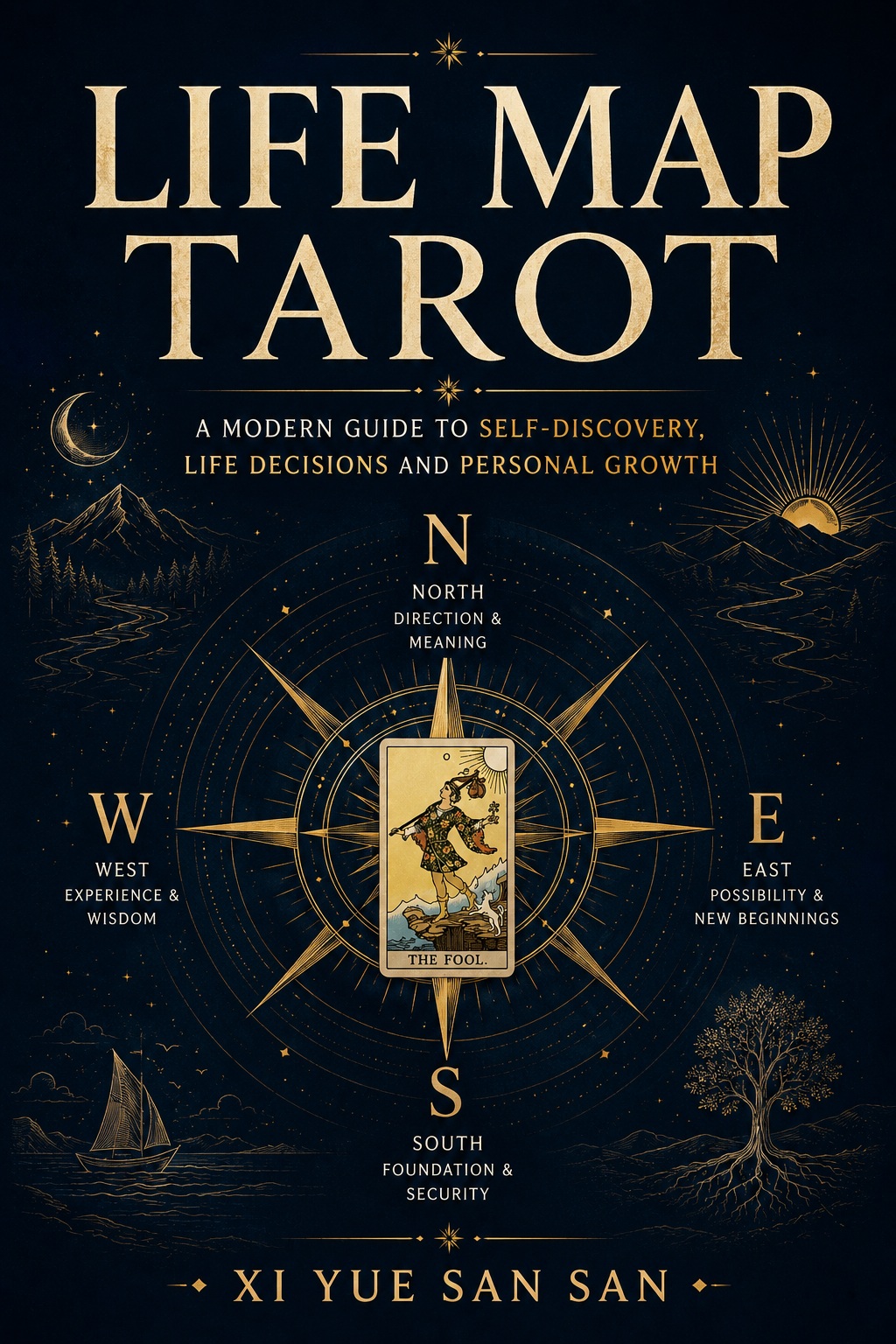
Book recommendation
Life Map Tarot
Books describes Life Map Tarot as a guide to decisions through tarot and self-reflection. It is a relevant companion when an unexpected invitation arrives and you want to understand your response before deciding whether the actual work fits your life.
Open the book page