You have three tabs open for crystals and one for the electricity bill. The bill is due Friday. One shop says you need protection, another says abundance, and the third has a pale pink stone photographed beside a linen cushion that costs more than your chair. You came looking for something small to help you feel less scattered. Somehow you are now comparing twelve things you might be missing.
Put the shopping tabs aside for a moment.
The question, what crystal energy do I need right now, can begin much closer to home. What quality would you like to remember during an ordinary day? Patience before answering a message. Permission to enjoy something. A little firmness when you start offering time you do not have. A stone can stand for that quality if you enjoy working with objects. You do not have to buy one to begin.
In this essay, crystal energy means the personal meaning you give a stone during reflection. A tarot reading cannot establish that your body needs a mineral, diagnose an energy problem, or prove that an object will change somebody else's behavior. What we can explore is simpler: an image, an object, and a choice you want to remember when life gets noisy again.
Start with the moment you want help remembering
Try finishing this sentence: I would like a reminder when I am about to blank. Make the blank a real moment. When I agree to another favor before checking my calendar. When I open a shopping app because the afternoon has gone badly. When I start apologizing for asking the waiter to correct my order. Your answer gives the practice a place to happen.
That is more useful than deciding you need better energy in every part of your life. Every part is exhausting. You might already have a job, a child who has lost a school shoe, and an unanswered message from your landlord. A personal ritual should be small enough to fit beside those things. Otherwise the ritual becomes another promise you cannot keep, sitting there looking beautiful and accusing.
Write your chosen moment on a scrap of paper. Then write the quality you would like to bring to it. Pause. Kindness. Honesty. Enough. None of these words requires a special purchase. If you have a pebble from a walk, a bead, or an old ring with a pleasant weight, it can hold the same reminder. The meaning comes from your agreement with yourself.
Let one tarot card suggest a quality
Shuffle if you want to, and ask, what would be useful to remember in this situation? Draw one card. Before reaching for a guidebook, describe what you see. A person holding something tightly. A figure resting. Someone looking toward water. Keep the observation separate from the story you build around it. Your first association can be useful without being an instruction from outside you.
Suppose you draw the Four of Pentacles while thinking about the shopping app. You might notice the grip on the coin and think about enough. Another day the same image might make you think about fear of spending even on necessities. Your actual circumstances decide which interpretation is worth considering. The card does not know your balance, and it cannot replace checking whether a purchase fits your budget.
Now choose an object that reminds you of the quality you named. There is no compulsory card-to-crystal table here. You can pair the Four of Pentacles with an ordinary gray stone because it looks plain and sufficient. Someone else might choose a clear piece of glass. A personal pairing does not become less meaningful because a shop would arrange its display differently.
A pale pink stone for a less punishing inner voice
If you already own rose quartz, you might use its pale pink color as a reminder to speak to yourself with a little more gentleness. This is a suggested association for this practice, not a claim about a mineral's healing properties. Pair it with the Queen of Cups if that image makes you think of listening before judging. Ask what a kinder response would sound like in today's actual difficulty.
Perhaps you sent an attachment with a typo in the filename. Your mind has turned this into a full review of your competence. A gentler response could be, I will send the corrected file and continue my morning. That sentence may feel annoyingly ordinary when you want certainty that nobody thinks badly of you. But certainty about other people's opinions is not something a stone can provide.
Leave the object near the place where you work, if that suits your space. When you notice it, read the sentence you chose. You do not need to feel warm toward yourself on command. You can still be irritated about the mistake. The small change is in what you do next: correct the file, stop adding insults, and return to the task that actually needs you.
A purple stone for taking your time
An amethyst you already have could stand for a pause. Perhaps its color feels quiet to you. Pair it with the Four of Swords and ask, where am I treating a reply as an emergency when it can wait? The useful answer might concern a group chat, a family request, or an email you have drafted while angry. Give the reminder a specific job.
For example, your sister asks whether you can host Sunday lunch. You are standing in a supermarket queue, holding melting frozen peas. Your automatic answer is yes, although you have not checked what else is happening. The pause could be one sentence: I will look at the weekend and let you know this evening. Nobody needs a speech about your spiritual practice. They need an accurate answer.
If you enjoy carrying a small object, you can associate it with that sentence. If carrying one is awkward or distracting, put the sentence on your phone instead. You have not failed the crystal practice by discovering that a note works better. The point was to remember the pause, and you are allowed to choose the reminder you will actually notice.
A clear stone for one question at a time
Clear quartz can be your chosen symbol for simplicity. Again, this is an invitation to make an association, not a promise that quartz clears thoughts. Pair it with the Ace of Swords if the image suggests one direct question. When you are tangled in possibilities, ask what you need to find out before taking the next step. Often it is less mysterious than the questions you have been circling.
You might be wondering whether a new role is your destiny, whether you will disappoint your team, and whether you are brave enough to change. The next useful question could be, what are the working hours? Or, can I speak with someone who does the job? These questions do not settle your whole future. They give you information you can use without asking a card to predict how every choice will feel.
Place your chosen object beside a notebook and write the question in one line. Then name a way to get the answer. Send the email. Read the actual contract. Ask the person involved rather than collecting more interpretations of what they might mean. A meaningful ritual can end in something as unromantic as checking the opening time of an office.
A dark stone for a boundary you can say aloud
If a dark stone such as black tourmaline appeals to you, you might let it represent a limit you want to keep. People sometimes reach for a protection object when a relationship leaves them drained. In this practice, the object is a reminder of your choices. It does not create a shield that makes another person's conduct harmless or removes the need to respond to what is happening.
The Seven of Wands could prompt a question about what you are being asked to defend. Is it your lunch break? Your decision not to discuss a private relationship at work? Your time after a long shift? Write a sentence that names the limit without defending your entire character. I am not available tonight. I would rather keep that private. I can help for twenty minutes.
Notice whether your proposed boundary is actually within your control. You cannot promise that someone will stop being annoyed. You can decide when you answer a nonurgent call or how much information you share. There may be consequences and constraints worth thinking through. A stone cannot make those disappear. It can remind you to stop treating your own needs as an embarrassing afterthought while you consider them.
Something bright for pleasure that needs no defense
You may want a yellow or orange stone simply because it cheers up a dull desk. That is an adequate reason to enjoy it. You could pair a bright object with the Sun and ask what you would like to do for pleasure this week. Resist turning the answer immediately into a goal that has to improve you. The pleasure is allowed to be small and a little pointless.
Maybe you miss drawing badly. You used to sketch people on the bus, mostly ears and coats, and stopped when every hobby seemed to require equipment and progress photographs. Put a pencil beside your bright object. Draw the mug in front of you for five minutes. Nobody has to see it. You do not have to build a creative identity around a mug with a crooked handle.
Or the pleasure is listening to a song while you put away plates. This may sound too slight when you wanted a reading about abundance. But abundance is a word that can hide very different wishes. More money requires attention to actual money. More permission to enjoy an uneventful evening might begin with admitting that you do not need to earn every pleasant moment through exhaustion.
When you want several stones at once
You might recognize yourself in all these examples. You want kindness, boundaries, clarity, rest, and a good time. Of course you do. The question is which reminder would be most useful this week. Choosing one does not deny your other needs. It gives you a chance to find out whether this particular practice helps before your bedside table turns into a collection of unfinished intentions.
Try making the choice without another draw. Look at tomorrow. Where is the likely difficult moment? A meeting, a call, the hour after work when you order things you do not really want? Choose a reminder for that moment. Keep the experiment short enough that you can describe what happened afterward. A week is plenty. Even one conversation gives you something concrete to reflect on.
If no object appeals to you, leave the choice open. Sometimes people feel pressure to report that a stone called to them. You can find something attractive without feeling chosen by it. You can also walk out of a shop empty-handed. A quiet response, or no response, is still information about your preference. There is nothing spiritually defective about being more interested in getting home for dinner.
Keep the ritual ordinary enough to repeat
Here is a simple version. Put your card and chosen object on a clear part of the table. Read your one-sentence intention. Think of the moment when you want to remember it. Name what you will do. Then put the card away. You can take thirty seconds or several minutes, depending on the time and attention you have. The ritual does not improve merely by becoming longer.
You do not need to introduce smoke, special liquids, elaborate cleansing instructions, or unfamiliar handling practices to give an object personal meaning. Keeping it where you can see it may be sufficient. Follow appropriate care information for anything you own. The reflective exercise here involves looking at an object and associating it with an action; nothing needs to be swallowed, burned, or applied to your body.
At the end of the day, write what actually happened. I remembered the pause after I had already said yes. That is a useful observation, even if it is annoying. Tomorrow you might put the reminder by your calendar instead. The object has no opinion about whether you performed well. You are testing where a reminder fits into your life, and the first arrangement may be inconvenient.
When the stone seems to have stopped working
Perhaps the first few days felt special, and now you walk past the object without seeing it. You do not have to interpret that as blocked energy or a sign that you need a more expensive crystal. The novelty may simply have worn off. Read the sentence again. Does it still describe the problem you wanted to address, or has the week moved on?
Maybe the boundary you were rehearsing has become easier, and now the difficulty is asking for help. Maybe nothing changed because the reminder was on a shelf you never look at. Maybe you discovered that pausing before a reply is harder when a particular person is involved. Each possibility suggests a different adjustment. None requires blaming yourself for failing to believe strongly enough in an object.
You can retire the practice. Put the stone with other things you enjoy, without a job attached. There is a relief in letting a beautiful object be beautiful again. It does not have to be responsible for your confidence, relationships, and future income. You may still feel fond of it because it accompanied a difficult week, and that personal history can be enough.
Leave with something you can actually use
Before you reopen the shopping tabs, read your original sentence. What did you want to remember? If a crystal you own makes that reminder more visible or more pleasant, use it. If a note, a coin, or an alarm works better, use that. If you mostly wanted a pretty object, be honest about that too. A purchase does not need a mystical explanation to be enjoyable when it fits your circumstances.
The next time the relevant moment arrives, it may be awkward. You may ask for time to think and then want to fill the silence with an apology. You may correct a mistake and still feel embarrassed. Keep the action small enough to do while the feeling is still there. Your stone can sit beside you, quietly. The sentence you practiced is the part you get to carry into the conversation.
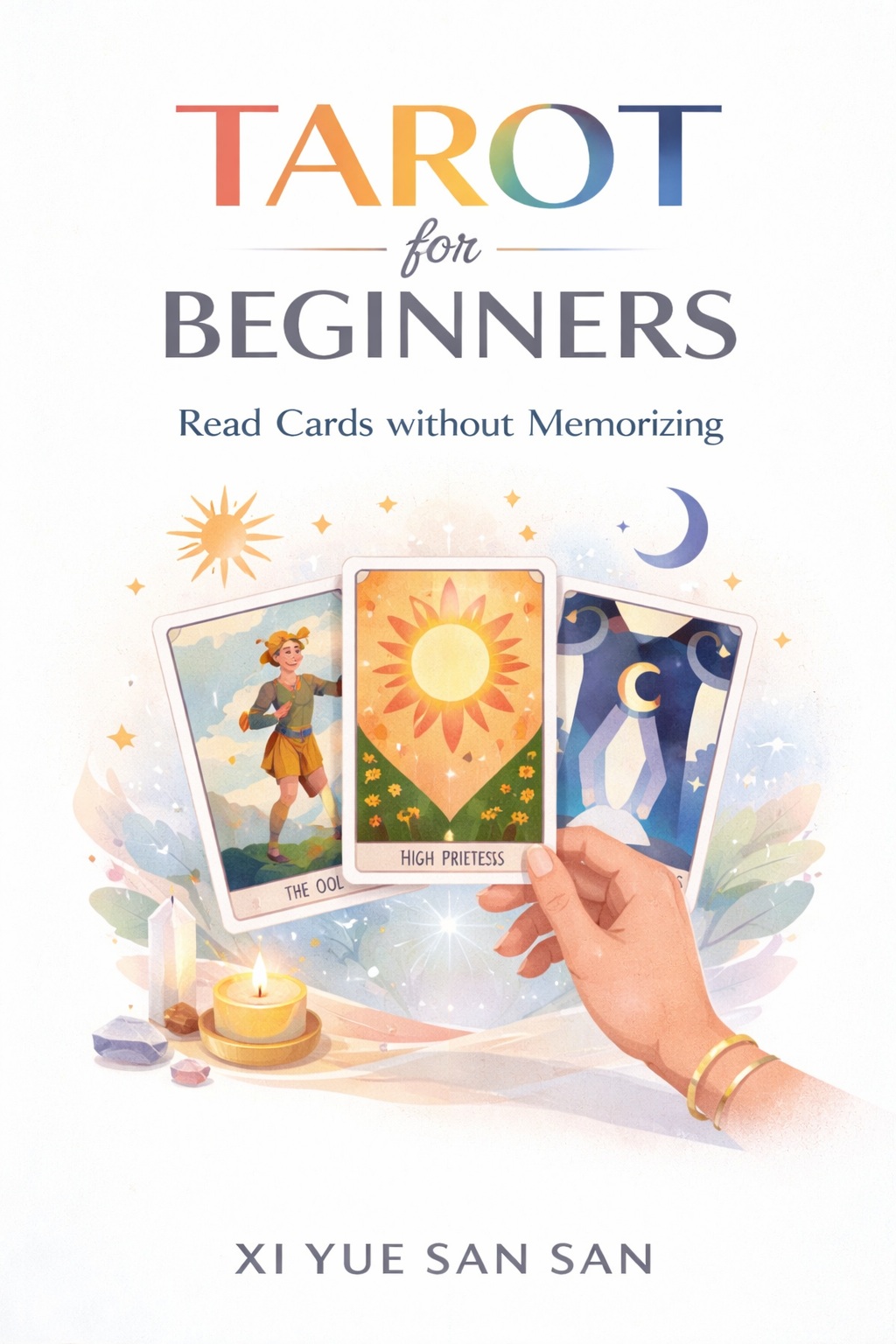
Book recommendation
Tarot for Beginners by Xi Yue San San. Books.html describes Tarot for Beginners as a way to read cards without memorizing. It fits this practice of looking closely at one image and choosing a personal association, without needing a fixed crystal correspondence table or another purchase.
Open the book page