You know the third person's name. You wish you did not. Now it catches your eye in a message preview, a story someone tells, a photo you were not looking for until you were. You want to be reasonable. You also want someone to tell you what is going on, clearly, so you can stop doing this terrible little calculation every time your partner reaches for their phone.
A love triangle tarot spread can give you somewhere to put those questions. It cannot establish that a triangle exists, reveal a third person's private intentions, or prove that your partner is lying. Those limits matter most when you are upset, because an evocative card can feel like the missing piece of evidence. It is still an image you are interpreting.
The spread here looks at your experience, your existing relationship, and what you know or assume about another person's involvement. It ends with a conversation and a choice that belong to you. You can use it when a triangle has been openly acknowledged, when you are uncertain, or when you are the person being kept at the edge of someone else's relationship.
Write down what happened before naming what it means
Begin with a plain account of the moment that brought you to the deck. “My partner canceled our plan and later said they spent the evening with someone else.” “We agreed to exclusivity, and they told me that agreement was broken.” “I saw a name on a screen and felt frightened.” These are different starting points. The spread should not treat them as interchangeable evidence of betrayal.
Next write what you do not know. You may not know whether there is attraction, whether a conversation has happened, or whether your partner understands your agreement in the same way you do. Leave those gaps visible. It can feel unbearable to write “I do not know” when you want a definite answer. Filling the gap with a card interpretation will not make the answer more reliable.
Then name your feeling without making it a charge against anyone. “I feel replaceable.” “I am angry that I found out this way.” “I am embarrassed by how much time I have spent checking.” You do not need to prove the worst possibility to admit that the situation hurts. Your experience can deserve attention while the facts remain incomplete.
Be clear about the relationship agreement
A triangle means different things in different relationships. Some people have agreed to exclusivity. Some have agreed to other arrangements. Some have never had a clear conversation and are discovering that they assumed different things. The relevant question is what was agreed, what has happened, and what each person is free to choose now. The number of people alone does not tell you whether someone broke trust.
Write the agreement in ordinary language. If you cannot, that may be the first conversation you need. “We were obviously serious” can carry a great deal of feeling without establishing what both people understood. That does not make your hurt foolish. It means there is something concrete to clarify, and a tarot reading should not quietly supply the missing agreement on everyone's behalf.
If a breach has already been admitted, do not use the cards to argue yourself out of what you know. You can explore whether you want to continue, what questions remain, and what would need to change. A pleasant card does not undo a broken promise. A difficult card does not require a particular decision before you have had time to think.
Lay out six cards with six clear questions
Place six cards in two rows of three, reading left to right across the top row and then the bottom row. The positions are: My Experience; Our Agreement; My Story About the Third Person; What Needs Clarification; A Boundary I Can Set; and My Next Step. Write those labels before drawing so the cards keep their jobs even when an image feels especially charged.
This layout deliberately avoids positions called Their Secret Feelings or Who Will Win. A person is not a prize, and a card cannot interview someone who is absent. The third position concerns your account of the third person, including the possibility that your account is incomplete or wrong. If you want a simpler reading about the partnership alone, try the five-card relationship spread.
Choose your reversal method in advance, or read upright. Decide that these six cards are the reading. You can consult the guidebook and leave a position uncertain. You will not keep adding cards until the third person looks less attractive, your partner looks more devoted, or the outcome becomes comforting. Those wishes are understandable. They are also reasons to keep the procedure simple.
Card one: let yourself describe the hurt accurately
The first position asks about your experience. With the Five of Cups, you might notice grief over the relationship you thought you had. With the Four of Pentacles, you might recognize how tightly you are holding the situation because change feels frightening. With the Queen of Wands, you might notice anger at having your own worth reduced to a comparison. These are invitations to speak honestly, not labels you have to accept.
Try a sentence that begins with “I feel” and stays with you. “I feel foolish when I remember defending them to my friends” says something different from “I feel that they are definitely planning to leave.” The second sentence is a prediction wearing the clothes of a feeling. You can write it in the assumptions column, but it should not pass unnoticed as evidence.
There may be an uncomfortable mixture. You want an apology and want the whole subject to disappear. You miss the person you are angry with. You resent the third person more than the partner who made an agreement with you. Notice the mixture without rushing to make it admirable. A reading can hold a feeling long enough for you to decide what you want to do with it.
Card two: read the partnership through its agreement
This position asks how you understand the relationship's promises and current behavior. Justice might prompt a question about fairness and accountability. Two of Pentacles could invite a look at how time and attention are divided. The Hierophant might bring spoken or assumed rules into view. Tie the interpretation to a real agreement or a specific unanswered question.
If you draw the Lovers, do not jump to “They will choose me.” Ask what choices and commitments are actually available. Has your partner said what they want? Have you said what you can accept? The Lovers card essay explores why this card can concern values and decisions as much as romance. An affectionate image cannot make an unresolved agreement resolve itself.
Also notice the temptation to use a difficult card as a character reference. The Devil does not prove that your partner is manipulative. Seven of Swords does not establish an affair. You can discuss concerning behavior directly when there is behavior to discuss. Keeping that distinction does not require trusting blindly; it requires being clear about why you believe what you believe.
Card three: examine the story you have made about the third person
This is often the hardest position. You may have imagined the other person as younger, easier, more exciting, less demanding, or somehow better at being wanted. A court card can seem to confirm the comparison immediately. Slow down. The court cards guide explains why a Queen or Knight is not a dependable identification of a particular person.
Ask, “What am I adding to the information I have?” If the Queen of Wands appears, perhaps you are filling in confidence and glamour because you have seen a flattering photograph. If the Seven of Cups appears, perhaps you have several competing stories and no way to choose among them. The useful work is noticing your interpretation, not announcing the third person's personality from the image.
An acknowledged third person still has an account you may not know. They might know about the relationship, misunderstand it, or have been told something different. You do not have to excuse anyone to admit that possibility. Nor do you need to investigate their private life through friends, fake accounts, or repeated readings. Your partner can answer for their own choices and agreements.
Card four: find the question a person could answer
The clarification position turns the reading toward a conversation. Translate the card into a direct question. With Justice, you might ask, “Are you willing to keep the exclusivity we agreed to?” With Two of Swords, “Is there a decision you are postponing?” With Eight of Pentacles, “What specific effort are you willing to make to repair this?” The question should make sense without mentioning tarot.
Choose one or two questions that matter most. You do not need a list designed to catch every possible inconsistency in one evening. If a fact is already established, ask about its implications instead of demanding the same confession repeatedly. If a fact is unknown, say what you observed and ask about it without presenting the cards as a witness.
An answer may be incomplete. Someone may avoid the question, ask for time, or say something you hoped not to hear. You can notice that response and decide what you need next. The reading cannot guarantee a productive conversation. If a direct conversation does not feel safe, you can skip it and focus on support and distance. A spread does not obligate you to confront anyone.
Card five: make the boundary about your participation
A boundary in this spread describes what you will participate in and what you will do if an arrangement does not work for you. It does not control the third person's behavior. “I will not continue an exclusive relationship while you also pursue someone else” names your limit. “You must stop feeling attracted to anyone” asks for something you cannot enforce or verify.
The Queen of Swords might prompt a clear statement. The Hermit might suggest time apart to hear your own preference. Four of Swords could invite postponing a conversation until you are less exhausted. These are possible prompts, not commands. Consider what is feasible in your circumstances. Shared housing, children, work, or other obligations can make the next step slower and more complicated than a card caption suggests.
You can state a limit without having a perfect plan for the rest of your life. You can also decide that you need advice from someone who knows your situation. Avoid letting a spread shame you for not acting dramatically. A measured next step can still be a serious one, especially when other people and practical commitments are involved.
Card six: choose the next thing you can actually do
The final card should lead to a step you can describe, such as arranging a conversation, writing down your questions, talking with a trusted friend, or taking an evening away from checking messages. “Become unbothered” is not an action. “Make them choose” is outside your control. Keep the step close enough that you know whether you took it.
If the card suggests waiting, give waiting a reason and a review point. Perhaps you agreed to speak on Saturday. Perhaps you need to understand your housing options. Waiting until a named condition changes is different from waiting indefinitely because a reader predicted that love would eventually win. You remain allowed to reconsider what the arrangement costs you.
Write a final sentence about what the reading did not answer. “I still do not know what my partner wants.” “I cannot know the third person's intentions from these cards.” This may feel unsatisfying beside a beautiful spread. It is useful. It leaves you able to hear actual information when it arrives instead of defending a story because you have already invested in it.
A worked example where the answer is still incomplete
Consider a fictional reader, Nina, whose partner has admitted developing feelings for a colleague. Nina draws Five of Cups, Justice, Queen of Wands, Two of Swords, Queen of Swords, and Three of Pentacles in the six positions. Her agreement was exclusive. Her partner says nothing physical has happened but has not answered whether they want to continue the relationship on that basis.
Nina reads the Five of Cups as grief and the Justice card as a prompt to return to the agreement. The Queen of Wands makes her compare herself to the colleague. In the third position, she notices the comparison as her own story rather than a description of the colleague. She has met this person once, for about ten minutes. That is not much information to build an entire rival around.
Two of Swords becomes a question about the postponed decision. Queen of Swords helps Nina draft her limit: she will not agree to an undefined arrangement while continuing to act as though exclusivity is settled. Three of Pentacles prompts her to talk with a trusted friend before the conversation. She closes the reading without a prediction about who will be chosen. She has a question she can ask and a limit she can explain.
If you are the person outside the existing relationship
Use the same spread, but write your actual arrangement in the second position. What have you been told? What has been promised? What has happened? A promise that someone will leave another relationship later is different from an available relationship now. You can care about them and still notice that difference without asking the cards to decide whether your patience will be rewarded.
The third position can examine your story about their partner. Be careful with a narrative in which that person is cold, controlling, or conveniently incapable of understanding them. You may have heard only one account. Your decision about whether to stay involved does not require proving that the other partner is a villain. It can rest on what the present arrangement offers and asks of you.
When you finish, put the spread away before opening anyone's profile. Give yourself a little time to hear your own notes. There may still be love, anger, and unanswered questions. The cards have not settled whose account is complete. What you can keep is a clearer description of your experience, the agreement that matters, and the next step you are willing to take.
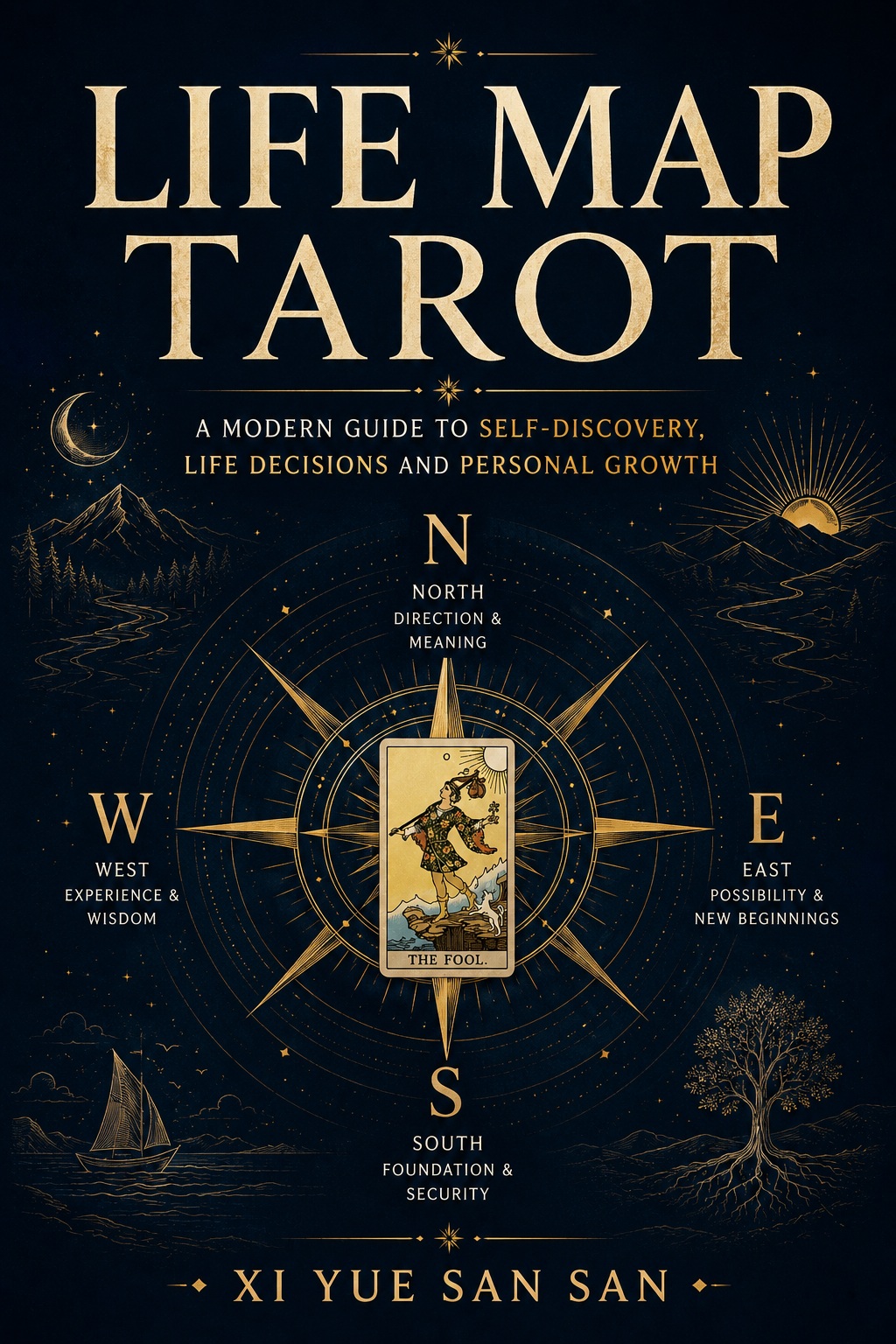
Book recommendation
Life Map Tarot. The catalog describes Life Map Tarot as a guide to decisions through self-reflection. It fits this spread's focus on understanding your own choices when other people's intentions remain uncertain.
Open the book page